
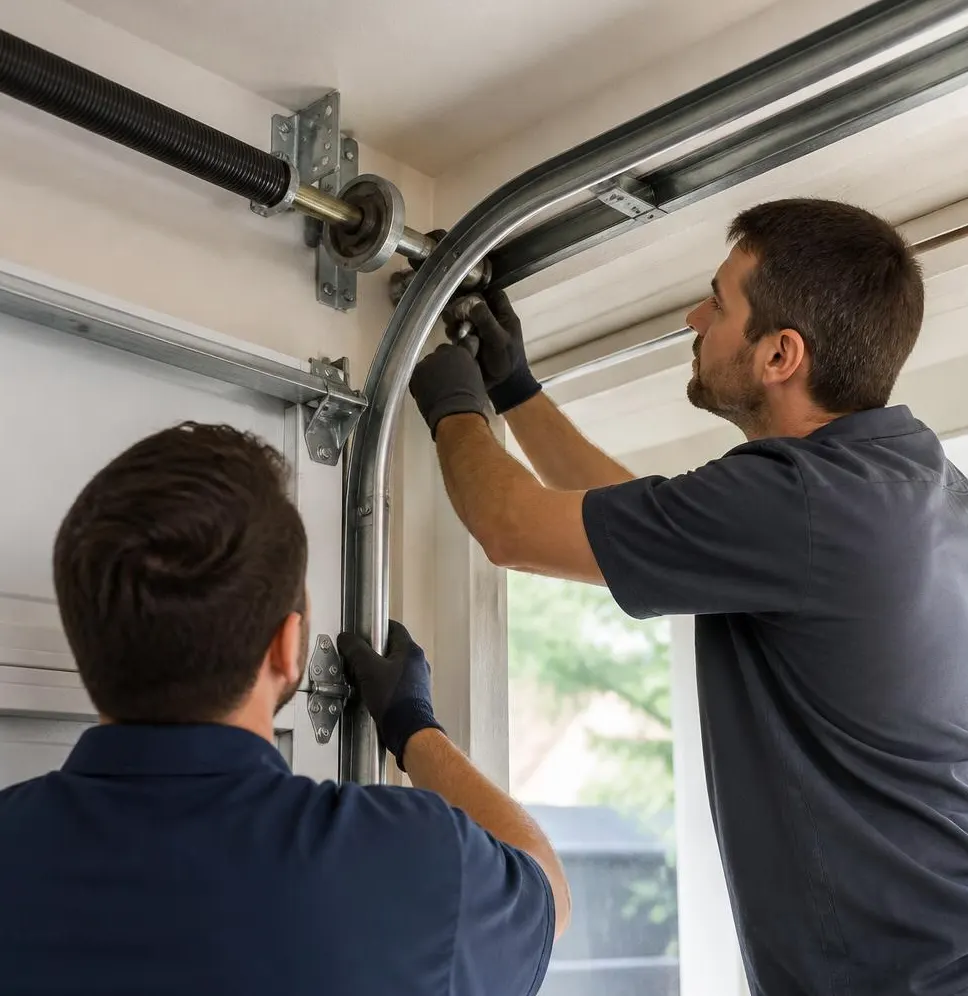
What a Technician Sees on This Call
The call usually starts the same way: "My garage door is crooked" or "it's hanging at an angle and won't move." On arrival, the picture is pretty consistent across Silver Spring, Wheaton, and Rockville homes alike—one bottom corner of the door sits lower than the other, a roller has popped out of its track, and somewhere between one and three panels show visible bowing or a crease. Often the opener is still engaged, quietly straining against a door that physically cannot travel where the motor thinks it should go. In older homes with original steel tracks, the misalignment has sometimes been building for months before it finally gave way.
How a Door Comes Off Its Track
A few patterns show up again and again in this part of Maryland. Humid summers swell wood-trimmed doors and framing just enough to push tracks out of true. Icy winters do the opposite—metal contracts, ice builds up in the track channel, and a door that closes fine in October suddenly binds and jumps the rail in January. Heavy rain and occasional coastal storms can warp wood framing around the opening over time, and in older housing stock, decades of minor shifts in the track brackets finally add up to real misalignment. A direct impact—backing into the door, a branch coming down on it during a storm—can knock it loose instantly.
Why It's More Than a Cosmetic Problem
A door off its track is still under tension. Torsion springs mounted above the door, or extension springs along the horizontal track, are storing enormous force—that's what normally lifts a 150 to 400 pound door with one hand. When a roller derails, that stored energy doesn't disappear; it can shift unpredictably, which is why a door that looks merely crooked can suddenly drop, swing, or buckle further if someone tries to force it.
What Not to Touch
- Don't touch the torsion spring or its cables. These are under load even when the door looks still, and they're the leading cause of serious injury on DIY attempts.
- Don't try to muscle the door back onto the track yourself. It may seem like a simple push, but a bent track or slipped cable can let the door drop without warning.
- Don't keep hitting the opener remote. Repeated attempts can bend the track further, strip the opener's gears, or snap a cable that's already under strain.
- Don't disconnect the opener and pull the door manually unless you've confirmed there's no visible cable damage or spring involvement—if either is compromised, manual force can cause a sudden fall.
What to Do Right Now
- Stop using the opener immediately. Unplug it or disengage the power if it's still trying to cycle.
- Clear the area. Keep kids, pets, and vehicles away from the door's swing path until it's assessed.
- Look, don't touch. Note which side is affected, whether a cable is visibly slack or frayed, and whether the spring looks intact. This helps a technician diagnose faster over the phone.
- If a car is trapped inside, use another entrance to the house rather than forcing the door for access.
- If a storm or freeze is coming, and the door won't close, cover the opening temporarily from inside if you can do so safely, to keep wind-driven rain or cold air out until repair.
When to Call Silver Spring Garage Door
A derailed door should never wait, especially heading into a Maryland winter when an open or unsecured garage invites freezing temperatures, moisture, and pests into an attached space. Our emergency garage door service is built for exactly this—same-day response to get the door off the strain point and back on safe footing. If the derailment involved a snapped cable or a spring that's lost tension, our team also handles spring replacement on-site, since springs and tracks often fail together and need to be addressed as a pair, not patched separately.
If your garage door has jumped the track anywhere in Silver Spring, Aspen Hill, Wheaton, Takoma Park, or nearby, stop using it and call Silver Spring Garage Door for prompt, safe repair before winter weather makes it worse.