
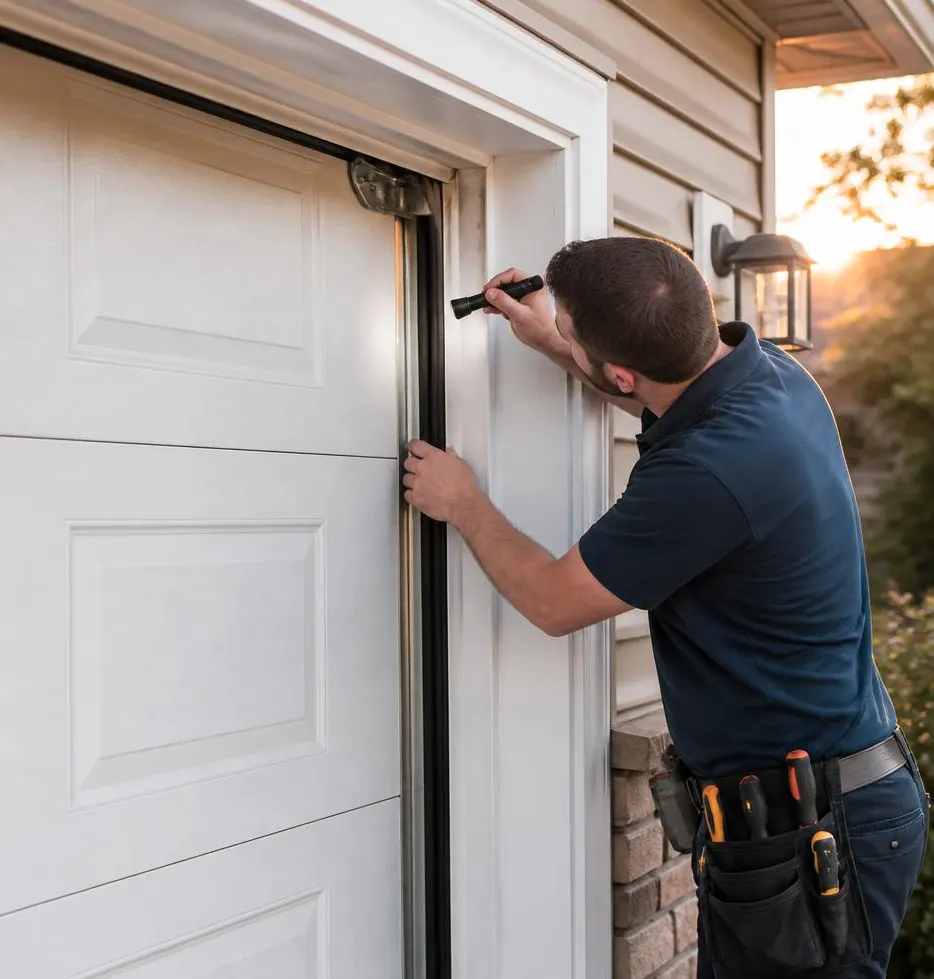
Direct answer: Most garage break-ins don't involve brute force. They exploit three weak points — an unsecured emergency release, an outdated opener, and a door that's left unlocked or cracked open. Close those three gaps and you eliminate the methods burglars actually rely on.
How Burglars Actually Get In
1. Fishing the emergency release with a wire or coat hanger
Older garage doors have a visible gap at the top where the emergency release cord hangs down. A thin wire slipped through that gap can snag the cord and pop the door open in seconds, no tools or noise required. This is one of the most common entry methods because it works on doors that otherwise look secure.
2. Prying the bottom corner
A flat bar wedged under the bottom corner of the door, combined with a hard upward pull, can pop a weak track or bend a thin panel enough to create an opening. This works best on older, lightweight doors or ones where the tracks haven't been tightened in years.
3. Code grabbing on old openers
Garage door openers built before the mid-2000s often use a fixed code that never changes. A cheap code-grabbing device can capture that signal from the street and replay it later to open the door remotely. If your opener still uses a dip-switch code panel, it's vulnerable.
4. Breaking a garage door window
Many homes, especially older housing stock, have garage doors with decorative windows near the top. A broken pane gives direct access to the emergency release or, if there's an interior door to the house, a reach-through to an unlocked knob.
5. The weak side door
The pedestrian door on the side of the garage is often protected by a cheap spring-latch lock instead of a deadbolt. It's frequently the easiest point of entry in the whole house, and once someone is inside the garage, they have privacy and time to work on the interior door to your home.
6. Doors left cracked or forgotten open
No tool needed here — just an open door. This happens more than people expect, especially when a door is left partway up to vent a running car or let out exhaust and never gets closed.
The Hardware and Habits That Stop Each One
- Shield or zip-tie the emergency release. A plastic shield covering the release mechanism, or a zip tie that still allows manual release from inside but blocks a wire from catching it, closes the most common entry point.
- Upgrade to a rolling-code opener. Modern openers generate a new code every time you use the remote, making captured signals useless. If your opener is original to an older home, this single upgrade removes an entire category of break-in.
- Add a slide bolt or ground-anchor lock. A simple manual slide lock on the inside of the door, engaged when you're away for extended periods, stops prying attempts cold since the track itself becomes the barrier.
- Put a real deadbolt on the side door. This is often the cheapest security fix in the whole house and closes the easiest point of entry.
- Keep remotes out of the car. A remote clipped to a visor is an invitation if the car itself is ever broken into or stolen. Use a keypad with a code you change occasionally instead.
- Add motion-activated lighting and a camera near the driveway. Visibility discourages the kind of quick, quiet attempt that relies on nobody noticing.
- Use app alerts if you have a smart opener. A notification when the door opens unexpectedly gives you a chance to react immediately instead of finding out hours later.
A few things worth knowing locally
Homes throughout Silver Spring, Aspen Hill, Wheaton, and the surrounding communities span decades of construction, and a lot of original openers and door hardware are still in service on older houses. If you've never replaced your opener, there's a good chance it's running the fixed-code system that's easiest to defeat. Winters here also bring a habit worth breaking: cracking the door open to vent a warming car or clear exhaust, then stepping away. That gap is an open invitation, cold weather or not. And when heavy rain or a coastal storm knocks out power, a door without battery backup can get stuck half-open or unlocked at the worst possible time — another reason backup power matters for more than convenience.
When to Call Silver Spring Garage Door
If your opener still uses an old fixed-code remote, if the emergency release isn't shielded, or if your door shows any looseness at the tracks or bottom corners, it's worth having it looked at before it becomes someone else's opportunity. Our Garage Door Opener Repair & Installation service can swap an outdated opener for a rolling-code model with app alerts and battery backup. Our Garage Door Maintenance visits check tracks, panels, and hardware for the kind of weak points that make prying easy, and tighten or replace what's worn before it's tested by someone who shouldn't be in your garage at all.
If you're in Silver Spring, Aspen Hill, Wheaton, Rockville, Takoma Park, Bethesda, College Park, or Olney and want your garage door checked for these weak points, call Silver Spring Garage Door today and we'll get it locked down right.